

The Address Is Technically Correct But the Freight Is Nowhere Near Here

The rate confirmation has an address. The address is real. The GPS likes it. The map pin drops with confidence, like it has personally unloaded flatbeds at this facility since 1987.
The driver follows it.
Forty miles of two-lane highway. Twelve miles of county road. One left turn past a sign that says “Authorized Personnel Only” in a tone that makes the steer tires feel guilty.
Then the GPS speaks with the bright, useless confidence of a hotel front desk clerk giving weather advice.
“You have arrived.”

No. The driver has arrived at a place. That place may even be the correct place in a legal, taxable, parcel-boundary sort of way.
But the freight is nowhere near here.
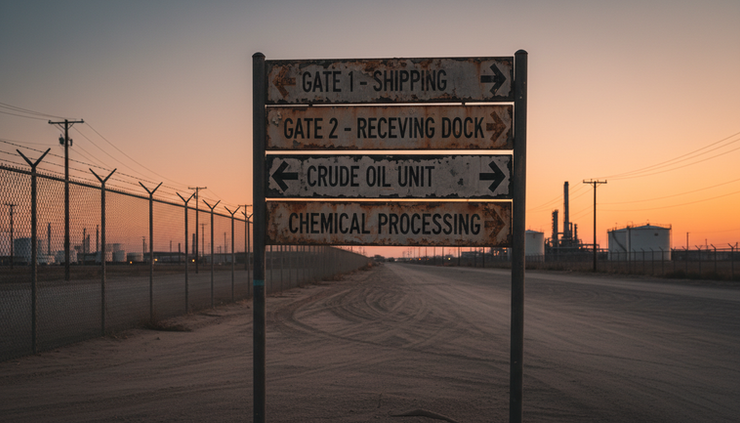
What sits beyond the fence is not a receiver. It is an industrial nation-state. There are gates, roads, tanks, trailers, guard shacks, badge readers, scaffolding, contractors, cranes, dust clouds, and at least one guy in a pickup who looks like he knows everything but refuses to make eye contact.
The delivery address was technically correct.
That is where the comedy begins.

The GPS has completed its job and abandoned the driver
A GPS is very proud of itself when it gets a truck to the nearest edge of a 600-acre facility.
It does not care that the actual receiver is behind a maintenance yard, past a scale house, through a contractor entrance, around a retention pond, beside a building with no number, and across from a trailer that has been “temporary” since the first Bush administration.
The screen says the destination is 200 feet away.
The guard shack says otherwise.
The driver rolls up to Gate 1 and gives the kind of polite nod used by people who are already bracing for paperwork.
“Delivery for Building 12.”
Security looks at the paperwork. Then at the truck. Then back at the paperwork, like the rate confirmation has just claimed to be a passport from Atlantis.
“You need Gate 4.”
Fine. Gate 4. We love Gate 4. Gate 4 sounds official. Gate 4 sounds like it owns a clipboard.
The driver loops around the outside of the facility. This road appears to have been designed by someone tracing the outline of spilled coffee. It narrows, widens, loses pavement, finds pavement again, and passes three signs that all seem to contradict each other.
Gate 4 appears.
Success.
No.
Gate 4 security says commercial deliveries enter through Gate 7.
Gate 7, as it turns out, is closed.
Not “closed for lunch.” Not “closed while we check something.” Closed in the permanent way. Cones, chain, faded sign, the whole ceremony.
The driver sits there, flashers on, looking at a gate that has clearly not welcomed a commercial delivery since people were arguing about flip phones.
Dispatch gets the first call.
“Hey, I’m at the address, but they’re saying Gate 1 is wrong, Gate 4 is wrong, Gate 7 is closed, and I’m pretty sure the GPS just filed for retirement.”
Dispatch does what dispatch does. Dispatch pulls up the rate con, stares at the same address, and enters the sacred phase of logistics known as calling everyone who should already know this.
The rate confirmation knows just enough to cause trouble
The rate confirmation says:
`Deliver to: 1840 Industrial Parkway`
That looks helpful.
Then it says:
`Building 12`
That looks more helpful.
Then the driver enters the complex and discovers every building is numbered except Building 12.
Building 3 is there. Building 8 is there. Building 14 is there twice, which feels illegal. There is a Building 12A, but it belongs to a contractor who says they receive pipe fittings, not the load currently on the trailer.
There is also a Building B-12, which sounds promising until someone explains that B-12 is a break room, not a dock, and please do not block the fire lane.
This is the gap between having an address and knowing where freight goes.
An address gets a birthday card to a mailbox. Freight needs more.
Freight needs the gate. The correct gate. The gate that is open. The gate that accepts trucks without making them reverse half a mile while a security guard says, “Yeah, this happens all the time.”
Freight needs the entrance, the dock number, the receiver name, the hours, the phone number that someone answers, and the local directions that survived contact with reality.
An address can be correct and still be almost useless.
That is the part people outside the truck do not always understand. A warehouse on a city block is one thing. A refinery, mine site, mill, oilfield lease, hospital expansion, airport jobsite, or manufacturing plant is a different animal. The address may identify the property. The delivery point may be ten turns, two checkpoints, and a safety vest away.

The locals give directions from a memory palace
After Gate 7 turns out to be decorative, the driver finds a pickup truck with a magnet on the door and a person wearing a hard hat in a way that suggests authority or at least familiarity with gravel.
“Building 12?”
The person nods slowly.
“Yeah, you gotta go around to the north entrance.”
Great.
There are three north entrances.
One is North Gate. One is North Contractor Access. One is Old North Road, which is blocked by a parked excavator and a sign that says “Do Not Enter” with no suggestions for emotional support.
The driver tries North Gate.
Wrong.
North Contractor Access?
“Depends who sent you.”
Nobody sent the driver. The rate confirmation sent the driver. The rate confirmation is not available for questioning.
Old North Road?
A man in a high-vis vest waves both arms in the universal language of “Absolutely not, future problem.”
Dispatch calls the delivery contact.
No answer.
Driver calls.
No answer.
Dispatch calls again.
Voicemail.
The broker says, “They know you’re coming.”
Excellent.
Somewhere inside this industrial maze, someone may know a truck is coming. That person is not holding a phone. That person is not standing at a gate. That person may be in a meeting, on a forklift, at lunch, or spiritually disconnected from the entire supply chain.
Then, finally, a second contact answers. This person knows exactly where the load goes and gives directions with the calm confidence of someone who has not been lost there since 2006.
“Okay, come in through the north entrance, go past the old compressor building, turn where the blue tank used to be, stay left at the second laydown yard, then we’re behind the fab shop.”
The driver pauses.
“Where the blue tank used to be?”
“Yeah.”
“What does it look like now?”
“Well, the blue tank’s gone.”
“When did they remove it?”
“2019, maybe 2020.”
This is not a direction. This is archaeology.
The driver has never seen the blue tank. The blue tank is not on the bill of lading. The blue tank is not in Google Maps. The blue tank lives only in the hearts of long-term employees and one laminated site map from before the expansion.
“Old compressor building” is another issue. Every building in the area looks like it has compressed something at some point. The second laydown yard is also hard to identify because the whole facility appears to be a sequence of laydown yards, each with the personality of a scrap metal yard and the signage of a haunted campground.
Still, the driver proceeds.
Past a building that might be old. Past a place where a blue tank might have lived a meaningful life. Left at a yard that could be second if you count with optimism.
And there it is.
A dock.
Maybe the dock.
A person on a forklift looks up and says, “You’re late.”
Of course.
Dispatch becomes a detective agency with worse coffee
From the driver’s seat, this whole mess feels personal. From dispatch, it looks like a live-action puzzle made of missing details.
Nobody wants the driver wandering around an industrial site. It burns hours, creates safety issues, blocks roads, annoys security, and puts everyone on edge. It also creates the worst kind of delay, the kind where the truck is “there” but cannot get unloaded.
That is why good dispatchers ask annoying questions before pickup. Not because they enjoy interrogating brokers. Not because they have a secret hobby in gate numbers. They ask because every missing detail becomes a phone call from a shoulderless access road.
The questions sound small:
Which gate receives commercial trucks?
Is that gate open at the appointment time?
Is there a security check-in?
Do drivers need a pickup number, PO number, badge, or escort?
What building, dock, pad, yard, or unit is receiving the freight?
Is the facility truck-friendly from that entrance?
Who answers the phone on site?
Are there site-specific directions that do not involve vanished landmarks?
That last one matters more than it should.
“Turn where the blue tank used to be” is funny until the clock is running, the appointment window is closing, and the driver is trying not to become the reason a plant road gets blocked.
The best directions are plain and current.
“Use Gate 4 off County Road 18. Do not use the main visitor entrance. Check in at the guard shack with PO 7731. After security, stay right for 0.4 miles, pass Buildings 3 and 5, turn left at the marked sign for Receiving, Dock 6 is on the east side.”
That is not poetry. It will never win an award. But a driver can use it without consulting a retired pipefitter.

The address is a starting point, not a delivery plan
Here is the uncomfortable truth sitting under the joke: the address is often the least useful correct detail on the load.
That sounds backward because addresses feel official. They appear on documents. They make software happy. They look clean in a system. But freight moves through messy physical places, and messy physical places need local knowledge.
A jobsite might share one address for every contractor trailer, crane pad, material yard, and receiving lane.
An oilfield lease might have a legal location, a gate code, a lease road, and a pad name, and none of those may show up in a normal GPS search.
A manufacturing plant might have one mailing address, one employee entrance, one visitor entrance, one shipping gate, one receiving gate, and one gate that everyone calls “the back gate” even though it faces west.
A construction project might move the delivery point every week. Yesterday’s unloading area is today’s concrete pour. Tomorrow it will be blocked by a crane. The address still works. The freight does not care.
This is why “They know you’re coming” should never be treated as a complete plan.
Who knows?
Do they know what is coming?
Do they know which carrier?
Do they know the truck needs a dock, a yard spot, a forklift, a crane, a pump, an escort, a badge, or a prayer?
Do they answer the phone?
A delivery goes well when information travels all the way to the cab. Not just to the shipper. Not just to the broker. Not just to a shared inbox called receiving. To the driver who has to turn a vehicle the size of a small building into the correct opening without becoming a facility incident report.
The best loads come with details that sound boring because boring is beautiful in trucking.
Boring directions save time. Boring gate numbers prevent chaos. Boring contact names get freight unloaded.
A dramatic delivery story is funny later. During the delivery, everyone would gladly trade the adventure for a clear sign and a person who answers the phone.
The happy ending involves a forklift and mild resentment
After the driver finds the dock behind the not-blue-tank and near the building that may or may not have compressed things, unloading takes nine minutes.
Nine minutes.
The search took an hour and a half. The unloading took less time than a gas station burrito decision.
The forklift operator signs the paperwork and says, “Next time just come straight here.”
The driver smiles the smile of a person who will carry that sentence into the afterlife.
Back at dispatch, the notes get updated.
Not just the address. The real directions.
Use North Contractor Access, not Gate 1. Gate 4 sends trucks away. Gate 7 closed. Ask security for Receiving Yard C. Building 12 has no sign. Pass the maintenance shop. Turn left at the yellow pipe rack. Do not follow GPS after the main road.
That is how the industry survives itself. One driver gets lost so the next driver gets slightly less lost. One dispatcher adds a note. One broker learns that “valid address” and “usable delivery information” are not the same thing. One receiver, maybe, someday, puts up a sign.
Until then, the address will keep being technically correct.
The GPS will keep announcing arrival at the edge of civilization.
Security will keep saying, “You need the other gate.”
And somewhere, deep inside 600 acres of tanks, trailers, contractors, ditches, and roads named after rumors, a forklift operator will look at the clock and wonder where the truck is.
The truck is there.
Technically.


Comments